 |
|
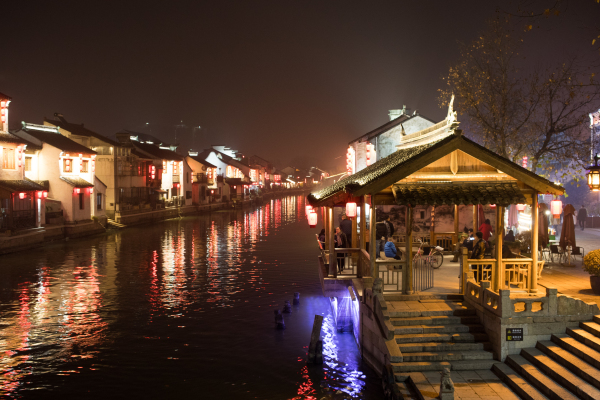
A night scene of the water town Wuxi that has witnessed a great improvement in water quality since the establishment of a water-protection system 10 years ago. [Photo by Gao Erqiang/China Daily] |
In the summer of 2007, large quantities of foul-smelling blue-green algae contaminated the famous Taihu Lake in Wuxi, Jiangsu province, affecting the water supply of more than 1.5 million residents.
The incident, which was caused by industrial waste produced by local factories, sparked widespread panic as residents rushed to stores to stock up on bottled water.
"When we turned on the tap, the water that came out was very foul-smelling," recalls Wuxi resident Ji Beilei, 33. "The small river that passes through our neighborhood turned deep green and emitted an odor. We had no choice but to leave our windows shut during this period."
But this unfortunate event did come with a silver lining. Liu Xia, deputy mayor of Wuxi, says that the city's officials and residents have become more aware of environmental issues following this episode and that a water-protection system has been created to prevent the recurrence of such an incident.
Today, government officials are assigned to take charge of protecting a specific waterway in their area. The names, contact details and responsibilities of these "river chiefs" are even printed on signs set up along the waters. Liu herself is the designated river chief for Lihu Lake, which is connected to Taihu Lake. Her duties include inspecting the water every week.
Since the establishment of the water-protection system, the average water quality in Taihu Lake has risen from below Grade 5, the lowest level, to Grade 4. More than half of the lake's 22 major feeder streams have attained Grade 3, according to the Taihu Basin Authority.
Wuxi's water-protection system has been deemed to be so effective that it is now being used as a model for other cities to follow. In December 2016, the central government ordered the system to be adopted nationwide by the end of 2018.
Other measures that local authorities have taken include shutting down factories that fail to meet environmental standards, building more water-treatment plants and initiating projects to rectify problems in river ecology.
In 2015, the city's Xin'an algae treatment center upgraded its capacity, allowing it to separate 3,000 metric tons of algae from water every day. Meanwhile, an ecology project in Lihu Lake that involved closing down fish farms, introducing aquatic plants and clearing mud from the riverbed has helped to enlarge the lake's area from 5.6 to 9.1 square kilometers and improve water visibility from 20 centimeters to 1 meter.
Zhang Haiquan, director of Wuxi's water resources bureau, says that the city is currently working on developing more water-treatment innovations.
"New materials, such as graphene, have been used in making purification and filtration devices. We will also build water-quality monitoring networks so that river chiefs will be able to inspect the condition of water using their smartphones in the future," he says.