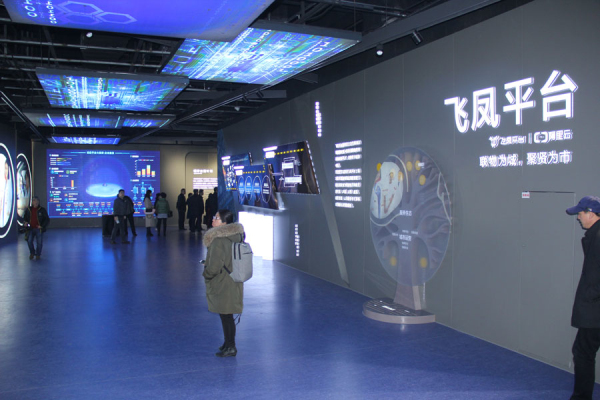
The Feifeng platform has helped Hongshan IoT Town to make medical, educational, transport, tourism, agricultural, medical and community services intelligent. [Photo provided to chinadaily.com.cn]
Editor's Note: Until a few years ago, economic stagnation bedevilled Wuxi, a city in East China's Jiangsu province. Now, for the first time, the local GDP exceeds 1 trillion yuan ($159 billion). This remarkable transformation came about on the back of industry upgrade. Based on extensive tours and interviews with key stakeholders, China Daily reporters capture the fascinating multifaceted story.
After inviting a host of industrial leaders and projects, Wuxi, a city about 130 km west of Shanghai, is ready to make 2018 a milestone year for the development of the internet of things or IoT.
Located in south of coastal Jiangsu province, Wuxi is already home to more than 2,000 IoT firms. By 2016, revenue from the IoT field exceeded 200 billion yuan ($31.6 billion), accounting for 45 percent of IoT revenue for the Jiangsu province and 24 percent of IoT revenue for China, according to Hong Kong-based Chinese-language newspaper Wen Wei Po.
In the past five years, Wuxi developed IoT as its strategic emerging industry, with annual growth exceeding 20 percent, and employment reaching 150,000.
By using technological and innovative talents, and by promoting key applications like cross-sector technology, Wuxi has formed a complete industry chain, ranging from sensors and network communications to processing applications and fundamental research, said Huang Qin, executive deputy mayor of Wuxi.
The 3.6-square-kilometer Hongshan IoT Town under construction in Wuxi exemplifies the developments.
The first of its kind in China, the high-tech area the town is located in has formed an IoT industrial cluster with 1,100 companies and 15 public industrial platforms in the past eight years, generating 115 billion yuan in revenue in 2016.
In three years, the town will be a miniature of the future world, a combination of reality and the digital world that is surrounded with thousands of sensors. The town will turn the idea of intelligent services across the medical, educational, transport, tourism, agricultural and community fields into reality.
Big-name Chinese tech firms such as Alibaba and Huawei have decided to set up new bases in Hongshan, expecting to power the creation of China's first IoT town.
All data from massive mainstream communication protocols and sensors in Hongshan will provide a data infrastructure for Hongshan town and generate comprehensive solutions for its urban administration using technology that enables big data to be managed and distributed.
For instance, it will be able to analyze the flow of traffic at major intersections in the town, changing the timings of the traffic lights to ease congestion and improve efficiency on the roads.
Cooperating with China Mobile, one of the three Chinese mobile communication giants, Tian-Net developed by Tian'an Smart Science & Technology Co has helped create intelligent transportation in China, said Yang Lei, the founder, chairman and CEO of Tian'an.
Yang believes it is the popularity of smartphones since 2010 that enabled mobile internet and its apps to penetrate every corner of people's daily life. "The popularity of the internet of vehicles, or IoV, will do the same to life and services related to the automotive industry in the next couple of years."
When Tian'an products are installed in the vehicle, drivers can take photos of realtime road situations or even the scenery alongside the car and send the images to friends by voice control, thus guaranteeing safe driving. These features are connected to an online cloud, where users can communicate with one another and even select the fastest route home.
Tian'an looks to double its users to 2 million and generate 300 million yuan in sales revenue and 5 million yuan profit this year.
By 2020, its users are expected to number 7 million, sales revenue and profit will likely expand to 900 million yuan and 60 million yuan respectively.
"An ecosystem of IoT industry is taking shape globally, and IT giants including Amazon, Microsoft, Intel, Dell, SAP ... all have made their foray into the sector," said Liu Haitao, president of the Wuxi IoT Research Institute, in an interview to Science and Technology Daily.
International Data Corporation said worldwide spending on the IoT grew 16.7 percent year-on-year in 2017 to just over $800 billion.
By 2021, global IoT spending is expected to reach $1.4 trillion as organizations continue to invest in hardware, software, services and connectivity that enable the IoT.
wang_ying@chinadaily.com.cn