 |
|
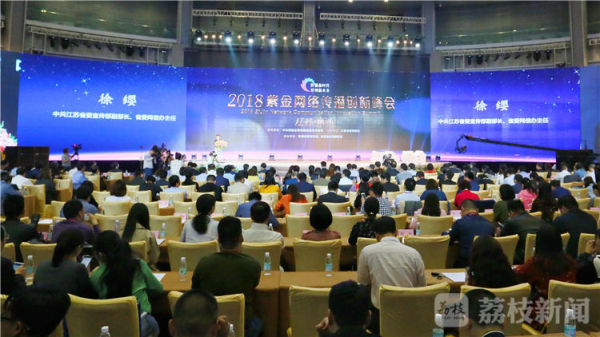
The 2018 Zijin Cyberspace Communication Innovation Summit kicks off in Changzhou, East China's Jiangsu province on April 27. [Photo/jstv.com] |
A media summit, centered on cyberspace communication innovation, convened in Changzhou, East China's Jiangsu province on April 27.
The summit is part of the province's broader push to echo the country's top leader's requirements in grasping the historic opportunity for informatization development in a bid to build strength in cyberspace.
Approximately 500 media representatives and experts across China attended the event, exploring the topics, covering internet communication platforms, content, forms and its integration with future high techs.
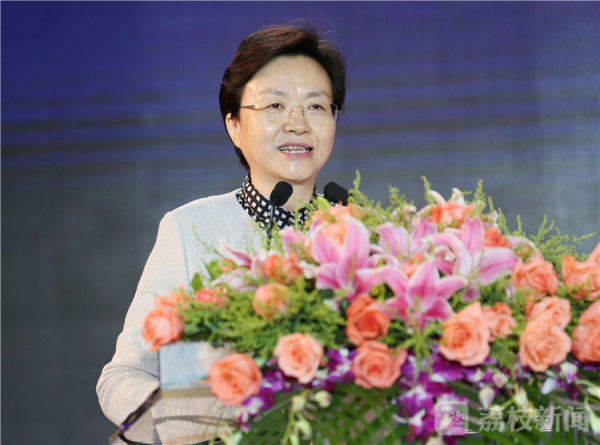
Cyberspace communication plays a key role in guiding social values, noted Wang Yanwen, director of Jiangsu Provincial Department of Publicity, at the conference.
She called on the internet media present to uphold the correct political direction, shouldering responsibilities to spread positive information and guide public opinion and values towards the right direction.
More efforts, she urged, should be in place to further domestic media influence with an innovative spirit, and proposed building the summit into a permanent platform for exchanges in the circle.
 |
|
Wang Yanwen, director of Jiangsu Provincial Department of Publicity, addresses the meeting held in Changzhou, East China's Jiangsu province. [Photo/jstv.com] |
It is an irreversible trend that media has entered the mobile internet era, pointed out Ding Wei, director of the new media center with People's Daily, adding that the content online platforms offer is increasingly valued and efforts in cyberspace governance would be further strengthened.
Ding's view struck a chord with Guo Bensheng, editor-in-chief of Xinhuanet, who compared premium quality content to "hard currencies" on information highways,considering its scarcity and high-value.
Shuang Chuanxue, publisher and editor-in-chief of Xinhua Daily noted that the integration of new emerging media with traditional formats not only entails technological revolution and updates, but also systematic and mechanical innovations.
In the face of fierce competition in hunting for new media talents, Bu Yu, president of Jiangsu Broadcasting Corporation, proposed more efforts in raising treatments for the young employees born in 1980s and 1990s, who are widely considered the "internet natives".
Liu Kang, deputy director responsible for the artificial intelligence project of Tencent Holdings Ltd, offered his insights into the role of the technologies like AI is set to play in media evolution.
Algorithms are virtual realities empowered by mankind's innovation and creativity, he said, adding that he hopes AI technology could help enhance work efficiency for media workers.
As of Dec, 2017, China's netizens number reached 772 million people, accounting for 55.7 percent of the total population, 4.1 percent higher than the world average, a report shows.
In Jiangsu, network connection has reached 49.03 million people, accounting for 61.1 percent of its total population. Among them, up to 98.4 percent have access to internet services through mobile phones.